I grew up in a world where phones sat on the kitchen wall, not in our pockets. Where we printed MapQuest directions, checked email once a day (if that), and boredom wasn’t something to be escaped with a quick scroll. Now, as a millennial mom raising four kids in the smartphone era, I’m reckoning with how radically different their childhood memories will be from mine—and how much my own attention has been stolen by the little screen I carry everywhere. This is the story of how I realized just how often I was reaching for my phone, and the system I’ve started using to reclaim my focus, my faith, and my life.
Life was simple.
I’m a millennial. I’m old enough to remember the house phone with the answering machine and our brand-new family AOL email account. I have zero childhood memories of my parents, grandparents, or caregivers scrolling their phones—because they didn’t….
Homework happened on a desktop computer. As a teenager, I AIM-chatted with friends, but that came later. I got my first cellphone at 14: a Nokia. I used it to call my parents, text my friends (painstakingly pressing “7” four times to type the letter S), and play Snake.
At 16, with a fresh driver’s license, I printed directions from MapQuest before driving somewhere new. If I needed something from Target, I just… went. And now? My kids’ memories will look nothing like that.
Instead of waiting for mommy to find the car keys, or wallet (why is it never in the diaper bag?), or another cup of coffee, they’ll remember me frantically searching for my phone before we can leave the house. Their caregivers, grandparents, uncles, aunts—all of us scrolling.
And to my shame, I know how much I reach for it. How often I tap the home screen for no reason. How often I unlock it with nothing to check.
We all know the psychology, but still: in a very Black Mirror way, this tiny device that can do almost anything is making us anxious, depressed, distracted—and stealing our attention from our real lives.
From our children. From each other. From God.
Small Hacks That Helped, Though Didn’t Cure
- Zero tolerance policy for phones at the table. Always, I can’t remember the last time a phone joined me and my husband at the dinner table.
- Phone sleeps in the kitchen (not on my nightstand) since 2017. Huge win.
- Deleted social media apps & accounts one by one. Facebook? Gone since 2012. Instagram was harder, but deleting it was the best decision. Snapchat deleted in 2019. TikTok never downloaded (thank God).
- Fewer notifications. For years, I only kept Messages + Calls on.
- Phone Sabbath. A full 25 hours from Friday night – Saturday night with no phone.
These things helped, but they weren’t enough.
The Tipping Point
One summer day, home with all four kids, I realized: I was compulsively checking my phone like an addict waiting for the next fix.
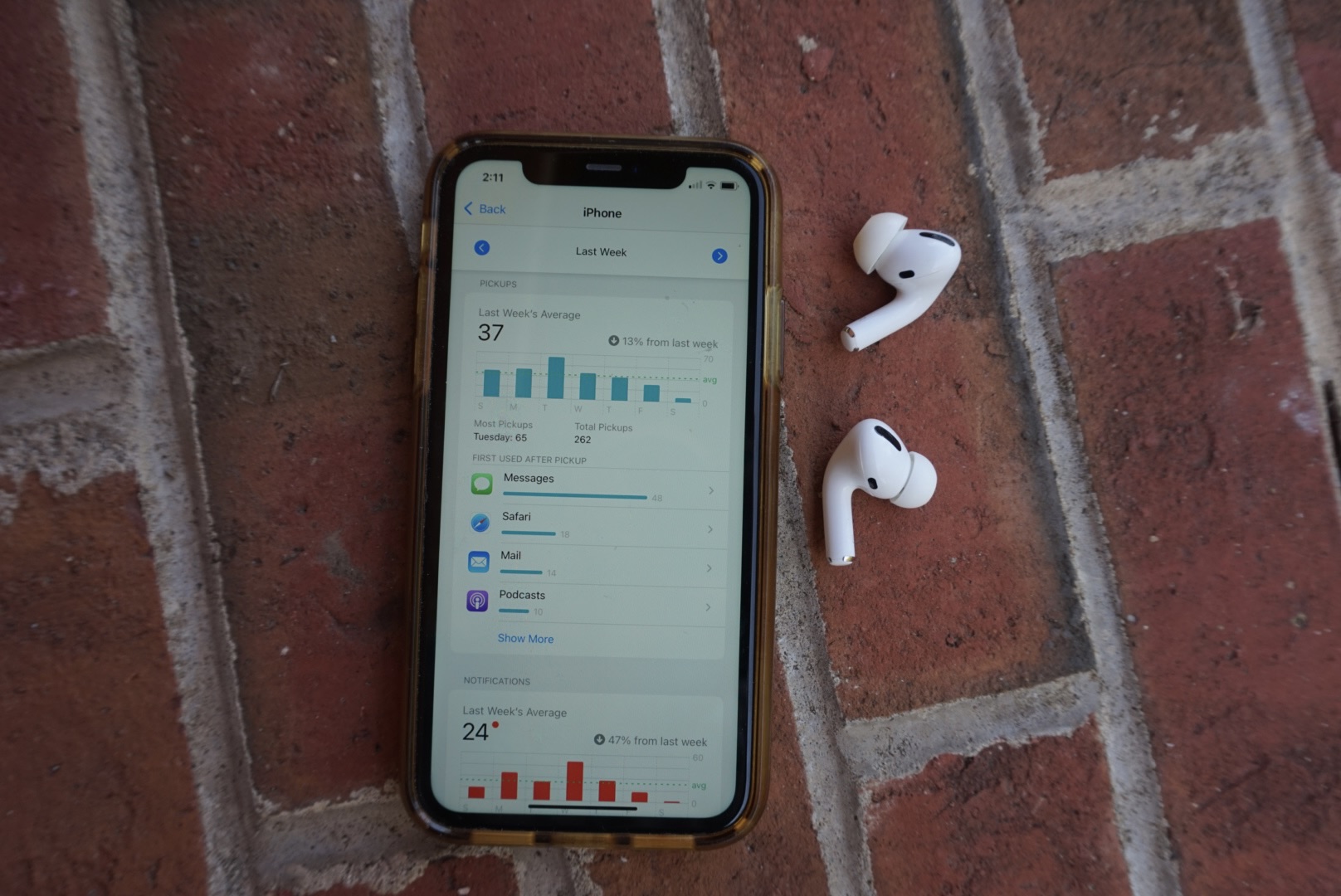
I peeked at my Screen Time report and felt sick. But here’s a big problem: screen time hours don’t tell the whole story.
Most of us think of screen time in hours—but hours can lie. Running Maps on a road trip or listening to a podcast while folding laundry racks up “usage,” even when the phone is locked and you’re barely touching it. What really shows the truth is pickups. Pickups measure how many times a day you reach for your phone, swipe it awake, and let it interrupt you. That’s your impulse meter.
Think about it:
- 40 pickups a day is about once every 20 minutes you’re awake.
- 100 pickups a day is once every 8 minutes.
That’s breakfast interrupted. Carpool interrupted. Laundry, story time, stirring the soup, waiting in line —interrupted. It’s not the minutes that steal from us, it’s the constant fragmentation, the way our attention gets sliced into tiny pieces until there’s none left to give to our kids, our spouse, or even ourselves.
That’s when I realized the better metric for tracking phone usage: pickups.
📊 For What It’s Worth
- Light users: 40–60 pickups / day
- Moderate users: 70–90 pickups / day
- Heavy users: 100–150+ pickups / day
Before tracking, I averaged in the 90s.
Ninety times a day I let my phone interrupt me. I interrupted my life to check my phone. What else could I touch 90 times a day?
📖 Replacing Pickups with Something Higher
I started thinking: If I can touch my phone 90 times a day, what else could I reach for instead?
Of course, my pickups can’t drop to zero—not in 2025. But they can go lower than the 40s. And more importantly, I can shift where I put that attention.
I want to live by God’s word. To align myself more fully with Him. So I decided to reach for something better than my phone: the Torah. I bought Rabbi Abraham J. Twerski’s book Living Each Day, a daily guide of scripture and prayer, and now I read (and reread) the day’s lesson as a way to re-center myself and reconnect with God, anytime I get the pull to check my phone.
It feels like a fabulous decision—and I encourage you to try something similar if you, too, feel that tug to put your attention somewhere holier, steadier, and more life-giving than the endless scroll.
✨ My New System
- 📵 No phone before 7:00 a.m.
- 🕰️ Designated check-in times (after big kids leave for school, mid-morning, before preschool drop-off, etc.).
- 💻 Emails only from my laptop, after lunch.
- 🛒 Shopping (Target, Amazon, etc.) only from my laptop.
- 🎨 Grayscale turned on.
- 🔕 Zero notifications. If I want to know, I have to go look. But only at the designated times.
- 📖 Daily grounding in faith. Alongside my practical rules, I’ve added something higher: reaching for Rabbi Abraham J. Twerski’s Living Each Day. Each morning I read (and often reread) the day’s passage, letting it anchor me before I let my phone set the tone.
And it’s working. My daily pickups dropped to an average of 43, less than half of what they used to be. It feels huge. It’s not perfect, and sometimes I slip. But I’m proud of where I am and the trajectory of where I’m taking this.

When I was little, no one reached for a phone as we were heading off to school, or while buckling a car seat, or as we waited for the popcorn to finish in the microwave. Life felt slower, not because there was less to do, but because our attention wasn’t constantly split. My kids may never know that world. But they will know me, and what I choose to model.
I hope to model an old-world approach in a new-world reality. In an age where everyone seems to scroll with a phone in hand, I want my kids to remember that mine was often tucked away in the kitchen drawer or left in the car when we went to the park.
Two weeks from now, I’ll share another update—what’s working, what I’ve added, and how I’m continuing to move the needle toward giving my children a childhood less shaped by cell phones. Thanks for being here with me on this journey.