Chapter 12: Go Forth!
God gives Abraham his first test. The first of ten, which we’ll dive into in a few chapters. “Go forth” and leave everything that is familiar to you and move to a place that is completely unknown. Interestingly, God doesn’t really give him direction, He simply says “go to the land that I will show you.” It’s important to note that this Divine commandment is for Abram to cut ties with his idolatrous environment.
12.7 The Lord appeared to Abram (Abraham) and said, “I will assign this land to your offspring.” And so Abram builds an altar right then and there to the Lord. Soon, there is a famine, so Abram continues to travel to Egypt for survival. The famine another test of faith from God.
As they pass through Egypt, Abraham fear he will be killed on account of his wife. It’s a very odd story, and it happens to be yet another test from the Lord. 12.13 “…Please say that you are my sister, that it may go well with me because of you, and that I may remain alive thanks to you.” The Bible does strongly suggest that lying sometimes is justified.The Ramban adds that this incident actually foreshadows Israel’s later exile in Egypt: famine drives descent; Israel (like Sarah) is endangered; divine intervention brings rescue and wealth. It’s a prophetic micro-story of the Exodus.
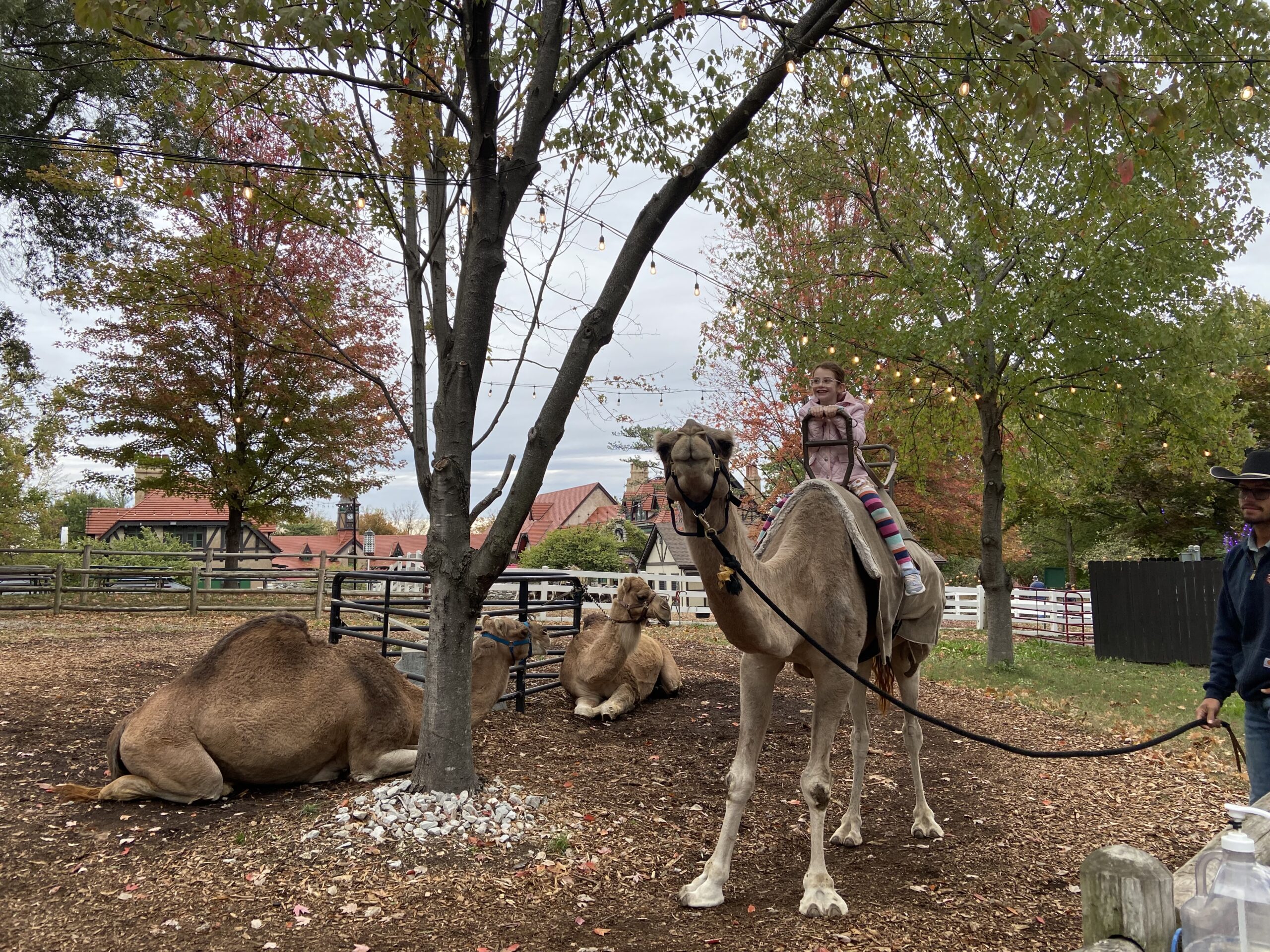
*Fun fact, Nahum Sarna makes an interesting point, in his book Understanding Genesis (thanks, Granddad!), Abram primarily used donkeys for transportation, rather than camels. My son’s coloring page (photo above), isn’t accurate.*
Chapter 13: Let there be no Strife
Abram, his nephew Lot, and his wife Sarai (Sarah), leave Egypt “very rich in cattle, silver, and gold,” but Abram’s first move isn’t to settle or expand — it’s to return. He goes back to the place between Bethel and Ai, where he had built his first altar, and “calls on the name of Hashem” again. Abram’s blessings now create new challenges: the land cannot support both his and Lot’s herds. Their shepherds quarrel — a small domestic tension, a struggle over land and resources. Abram takes the high road: 13.8 Abram said to Lot, “Let there be no strife between you and me, between my herdsmen and yours, for we are kinsmen.” Abram gives his nephew first choice of land.
Lot chooses to settle near Jordan, as it appears “like the garden of the Lord,” despite that the inhabitants of the land are wicked (13:13). Rashi notes that after Lot had departed, God speaks to Abram more often and at greater length. God promises again to give the land to him and his offspring, and also promising him that he would have many descendants, yet his wife was barren. 13.16 I will make your offspring as the dust of the earth, so that if one can count the dust of the earth, then your offspring too can be counted. More on this below, because it’s very poetic, and stuck out to me…
Chapter 14: Battle of the Kings
Lot gets caught up in the kings war. And when Abram hears of this, he summons his entourage, three hundred and eighteen men of his household, and goes to war. It’s been said many times about Abram; he pursued peace, but he was prepared for war and went to war when it was needed. Abram joined forces with Sodom, a city which has already been described as evil (13:13 Now the inhabitants of Sodom were very wicked sinners against the Lord.), and was victorious. Sometimes we are morally bound to fight alongside bad people in order to defeat worse people. The King of Sodom is grateful to Abram and offers him possession and money, but Abram refuses, 14.23 I will not take so much as a thread of a sandal strap of what is yours; you shall not say, ‘It is I who made Abram rich.’
Chapter 15: Look toward heaven and count the stars + the first Covenant with Israel
This is an important chapter, God appears to Abram in a dream. Interestingly, God communicates through visions or dreams, only Moses communicated with God “face to face.” Anyway, The Lord says to Abram 15.1-2 He said, “Fear not Abram, I am a shield to you; Your reward shall be very great.” And Abram counters God, that he is currently childless, and so his household steward, Damesek Eliezer will end up being the heir. God reassures him, for the second time (the first being 13:16), in a very poetic way; 15.5-6 He took him outside and said, “Look toward heaven and count the stars, if you are able to count them.” And He added, “So shall your offspring be.” And because he put his trust in the Lord, He reckoned it to his merit.
The Torah credits Abram for trusting in God, not for believing that God exists. Trust in and belief in are separate and very different. But more importantly, this is also a lesson on never loosing hope, regardless of how bleak a circumstance — like a barren, ninety year old wife — may be. As we all know, hopelessness can be a self-fulling prophecy.
In this dream-state God is telling Abraham all about his plan for his offspring, how they will be strangers in a land that is not their own, enslaved and oppressed four hundred years. Which we can only conclude that God knows what will happen to the Israelites, and most importantly, plays a role in it happening. The Lord asks Abram to bring him four animals and then puts him into a deep sleep, the same Hebrew word (tardema) which was used to describe the sleep of Adam when God used his side to fashion a woman.
God continues speaking to Abram, letting him know that in the end, serving four hundred years of oppression, his people shall go free and, 15.15 As for you, You shall go to your fathers in peace: You shall be buried at a ripe old age. The Torah never directly declares there is an afterlife, but it’s implied. The Torah is very preoccupied with life here on earth.
God then makes his first covenant with the Israelites, who later become the Jews. This is Gods second covenant with humanity (the first was the covenant with Noah — Genesis 9:8-17), and unconditional as each demands nothing from human beings.
The Lord’s Poetic Metaphor
Between this weeks parsha and the next few, The Lord uses a very poetic metaphor to convey to our patriarchs that their legacy will be numerous. Five total:
- 13:16 — 🌍 Dust of the earth. “I will make your offspring as the dust of the earth, so that if anyone can count the dust of the earth, then your offspring too can be counted.”
(God speaks to Abram after Lot departs.) - 15:5 — 🌌 Stars of the heavens. “Look toward heaven and count the stars, if you are able to count them… so shall your offspring be.” (God speaks to Abram in a vision.)
- 22:17 — 🌊 Stars and sand. “I will bestow My blessing upon you and make your descendants as numerous as the stars of heaven and as the sand on the seashore.” (God speaks to Abraham after the binding of Isaac.)
- 26:4 — ⭐ Stars again (to Isaac). “I will make your descendants as numerous as the stars of heaven, and I will give to your descendants all these lands…”
(God reaffirms the promise to Isaac — Abraham’s son.) - 28:14 — 🌾 Dust again (to Jacob). “Your descendants shall be like the dust of the earth, and you shall spread out to the west and to the east, to the north and to the south…” (God repeats the promise to Jacob in his dream at Bethel.)
Isn’t that so interesting?
Chapter 16: Sarai’s Good Intentions, Bad Execution
Ten years later, in Canaan, Sarai is still barren, so she concocts a plan to have Abram conceive a child with her Egyptian maidservant, Hagar. Abram heeds the request, and lo and behold, a baby is conceived. Sarai is understandably upset. And she treats Hagar badly.
The Torah doesn’t shy away from describing biblical heroes as flawed people, specifically this chapter with Sarai, and her harsh treatment inflicted upon Hagar once she conceived Abram’s child (understandably, who wouldn’t be jealous?!). Torah scholar Nehama Leibowitz cautions that before people undertake a mission that requires moral and spirit discipline, they should first make sure they posses moral and spiritual discipline. It is not enough to have good intentions. Hagar runs aways, and an angel finds her. God makes it a point, once again to prove that He cares about everyone, not just Jews. He tells Hagar to go back to her mistress, submit to her harsh treatment, and 16.9 And the angel of the Lord said to her, “I will greatly increase your offspring, And they shall be too many to count.” This carries a similar echo to what The Lord himself tells Abraham, Isaac, and Jacob, but doesn’t quite have that same poetic ring, right?
It’s also important to note that there are a handful of instances in the patriarchal stories where a man is promised many descendants, but Hagar is the only woman honored with this revelation. The angel tells her she shall bear a son, and shall call him “Ishmael”, which means, “God hears.” Abram was eighty-six years old when Hagar bore Ishmael.
Chapter 17: God Has a Sense of Humor
Thirteen years later, God speaks again to Abram. He wants to establish a covenant with him. God renames Abram, his new name shall be Abraham, in Hebrew it is “Avraham” which means Father of Many.
17.7 I will maintain My covenant between Me and you, and your offspring to come, Dennis Prager makes a really brutal, but honest point: “It must be admitted that neither party has done a particularly effective job. God has kept the Jews alive — but just barely, given how many Jews have been slaughtered throughout their history. And for the last two thousand years, the Jews have not done a particularly good job at spreading awareness of God and the Torah’s values.” ….yikes….but fair point.
ANYWAY. 17.10 Such shall be the covenant between Me and you and your offspring to follow which you shall keep: every male among you shall be circumcised. God renames Sarai, her new name shall be Sarah. And God promises to bless her with a son, that will give rise to nations. Abraham finds this hilarious, laughs, and says to himself, “can a child be born to a man a hundred years old, or can Sarah bear a child at ninety?” God declares they will name him “Isaac”, which means “laugh” in Hebrew, as Sarah too will laugh when she hears the news of their soon-to-be child.
Abraham asks about Ishmael, God heeds him, and promises to bless him, making him fertile and exceedingly numerous, and also reiterating that the covenant is solely through Isaac: 17.21 But My covenant I will maintain with Isaac, whom Sarah shall bear to you at this season next year.” Abraham hops to and circumcises himself, his 13-year old son Ishmael, and all his household.
TAKEAWAY FROM THE WEEK
- Faith sometimes begins by leaving what’s familiar.
- Blessings create new tests — new level, new devil; choose peace over pride.
- Good intentions aren’t enough — we need patience and spiritual discipline.
- God’s promises may sound impossible, but laughter is a form of faith, and brings lightness to the heart.
Side note: “Do not fear” is one of the most frequent statements of God to man in the Bible.