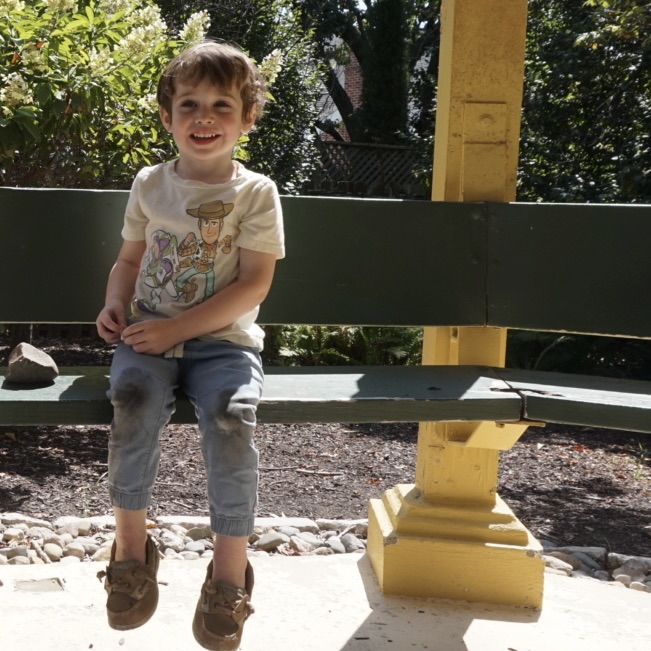
It’s hard to say Chayei Sarah without enunciating it like our three-year old: Chay-YEY. When you answer him in a way that satisfies him, or he sees something he likes. Yey! You just have to be there, I guess.
Chapter 23
Sarah’s lifetime reaches the perfect age of 127. It’s to be noted that she is the only woman in the Torah whose age at the time of her death was recorded. Sarah’s age of death was 127, one-hundred-twenty being the ideal lifespan (Genesis 6:3) + the sacred number seven. It’s also strongly implied that Abraham and Sarah were not living together at the time of her death. The remainder of the chapter is Abraham asking the Hittites to sell him a burial site for his beloved. It’s important to note that even if God makes promises, humans need to act to fulfill them. So yes, God did promise Abraham this land, and currently he needs a plot of land to bury his wife, so for four hundred shekels of silver, a cave is purchased. All our patriarchs and matriarchs (all but Rachel) will end up buried here. “After the Western Wall, it has remained throughout history the most sacred monument of the Jewish people.” – Sarna. Abraham ensured to make this transaction public, to emphasize that Abrahams’ right to the land could not later be questioned or challenged.
Chapter 24
This is the longest chapter in Genesis, and interestingly enough, it centers around marriage. Abraham recruits one of his senior household servants, Eliezer, to go back to the land of his birth to get a wife for his son Isaac. Though the people there were a bit confused about how to serve God, they were decent and considerate people. From that, we can gather a profound lesson, if a person is brought up in a society that lacks basic decency, it will be incredibly difficult for them to become a kind person, and it is clear that the Torah believes in shared values. Eliezer travels to the city of Nahor, and prays to God for the help to find a wife for Isaac 24:12 And he said, “O Lord, God of my master Abraham, grant me good fortune this day, and deal graciously with my master Abraham: He comes to a spring as the daughters of the townsmen come to draw water, hoping one will exhibit decent treatment of a stranger (read: goodness). And lo and behold, we meet the beautiful and good Rebecca, who is not only good to Abrahams servant, but who insists on watering all ten of Eliezers camels as well. She welcomes him, his crew, and animals to her home, where he then tells his tale to her family. He requests for her to return with him, to become his masters wife. Her family agrees, and then asks Rebecca herself for her permission. She agrees, and off she goes. 24:67 Isaac then brought her into the tent of his mother Sarah, and he took Rebekah as his wife. Isaac loved her, and thus found comfort after his mother’s death.
This paragraph in Up to God by D’vorah Miller, in one of her Chayei Sarah chapters, rings true to me, and worth sharing: “Spouses are living on quicksand if they are living without kindness. Kindness is the foundation of any meaningful, lasting relationship, and long lives deep kindness when it settles in prioritized boundaries. When kindness is harnessed and consciously given in such a way that the most consistent dose is give to my spouse, then to my children, then parents, then family, then friends, then others, the kindness grows as a tended-to garden.”
Chapter 25:1-25:18
Abraham passes at one hundred seventy-five years old. Before his death, he gives gifts to the sons he had with Keturah and sends them eastward, settling his affairs and reaffirming Isaac as the covenantal heir. Both his sons, Isaac and Ishmael, come together to bury him in the cave Abraham purchased to bury Sarah — a big moment of reconciliation after so many years apart. Chayei Sarah is the closing parsha on Abraham and Sarah’s story and the opening of the next generation. We then move through the line of Ishmael. It’s noteworthy that there’s a significance to the number twelve here: the twelve sons of Ishmael, the twelve Arabian tribes, the twelve Edomite tribes, and of course, the twelve tribes of Israel. This genealogy isn’t filler; it’s the fulfillment of God’s promise to Hagar and to Abraham that Ishmael, too, would grow into a great nation.
Abrahams Ten Tests
Abraham faced ten large obstacles in his lifetime, given to him by God directly, to test his faith and obedience. Now that we’re closing the chapter on Abraham, it’s important to look back and note his greatness.
“The ten tests with which Abraham, our father, was tested are all [in] the words of Scripture. The first is his emigration by God’s statement, may God be blessed – “Go forth from your land, etc.” (Genesis 12:1). And the second one is the famine that was found in the Land of Canaan when he came there and it was [the land of] his destiny – “and I will make you into a great nation” (Genesis 12:2). And this was a great test, and it is its saying, “And there was a famine in the land” (Genesis 12:10). And the third was the injustice of the Egyptians towards him in the taking of Sarah to Pharaoh. The fourth is his fighting against the four kings. The fifth is his taking of Hagar as a wife after he despaired of giving birth through Sarah. The sixth is the circumcision that he was commanded about in the days of his old age. The seventh is the injustice of the king of Gerar towards him in his also taking Sarah. The eighth is the expulsion of Hagar after his being built (having a child) from her. The ninth is the distancing of his son, Yishmael… And the tenth is the binding of Yitzchak.” – Rambam on Pirkei Avot 5:3:1
Take Away for the Week
If there’s one thread that runs through Chayei Sarah, it’s kindness — the quiet, steadfast kind that builds homes and sustains generations. From Abraham’s generosity in securing Sarah’s resting place, to Eliezer’s prayer for a woman who would show simple goodness at a well, to Rebecca’s instinctive compassion that reveals her as the next matriarch, every act moves the story forward through kindness. It’s the truest measure of faith — not in grand gestures, but in how gently we treat the people entrusted to us. As D’vorah Miller writes, kindness must begin at home, between spouses, and then ripple outward. It’s the soil from which love, peace, and legacy all grow.