
When I first got my copy of The Rational Bible by Dennis Prager, I remember feeling genuinely elated. This ancient, often dense and difficult text was finally opened up in a way I could understand—clear, thoughtful, and deeply engaging. And, maybe just as meaningful to me, it was written by a Jewish author.
A lot of the accessible, lay-friendly Bible commentaries I’ve found come from Christian writers—which can be wonderful (if you’ve been following along, you know I’m a big fan of John Mark Comer). But there’s something uniquely grounding about learning from someone who shares your foundational perspective. It adds a different kind of clarity. So when I realized that Prager’s Rational Bible series skips Leviticus (for now), I had to shift gears a bit. I leaned on Sefaria to get through that stretch—grateful for it, but it just wasn’t the same as sitting down with a physical book and a highlighter in hand.
Now, I’m back. Highlighter ready. Pages turning. Welcome to Numbers—Bamidbar.
Our book opens with God asking Moses and Aaron to take a census of Israel, likely because something significant—perhaps even battle—lies ahead. A strong indication of this is that they are instructed to count only men aged twenty and up, those eligible for military service. What I find remarkable is how this moment reflects a promise fulfilled. If we trace back just a few generations to Abraham—before Isaac was even born—and then fast-forward to this scene, we see just how fully God has followed through. The sheer number of descendants is staggering. That said, a lot of scholars point out these numbers probably aren’t meant to be exact. It’s more about showing just how big this moment is. Either way, something major is coming for this generation in the wilderness.
The Double Portion Twist
Interestingly, of Jacob’s twelve sons, Joseph receives a “double portion” through his sons Ephraim and Manasseh, which reflects his elevated status among Jacob’s sons. Thereby bringing the total tribes to thirteen, however, God makes an interesting point, that Levites shall not be counted in specific censuses. Therefore, it preserves the symbolic number of twelve tribes when Levi is set apart. This shows intentional structure in how God organizes His people—nothing is accidental.
The Levites are not counted because their role is fundamentally different. While the other tribes are being prepared for warfare and land inheritance, the Levites are set apart for spiritual service. They are responsible for the tabernacle, which represents God’s presence among the people. This creates a powerful contrast: some are counted for battle, others are set apart for worship. That division reinforces the idea that Israel’s survival depends not just on military strength, but on maintaining a right relationship with God.
God’s instructions for the tribe of Levi reveal that worship in Israel was never meant to be vague or spontaneous, but carefully ordered and deeply intentional. The Levites themselves were divided into three distinct groups—the Kohathites, Gershonites, and Merarites—each with clearly defined responsibilities surrounding the tabernacle. The Kohathites were entrusted with the most sacred objects, including the Ark of the Covenant and other holy furnishings, emphasizing both privilege and the weight of handling what represented God’s presence. The Gershonites were responsible for the tabernacle’s coverings and curtains, while the Merarites managed its structural components like frames and bases. Together, these roles show that every detail of worship required precision, cooperation, and obedience. Holiness, in this context, is not just about intention or feeling, but about faithfully carrying out the specific tasks God assigns.
Foreshadowing
Judah is clearly the largest of all the tribes by far, and it’s tribe size isn’t just a statistic—it foreshadows leadership. Later in Scripture, Judah becomes the dominant tribe (eventually producing King David and, in Christian theology, Jesus). Even here, Judah’s prominence hints at future influence.
And finally, we’re given an idea of how Israel camped in the wilderness, enjoy this map I found from bible study.org:
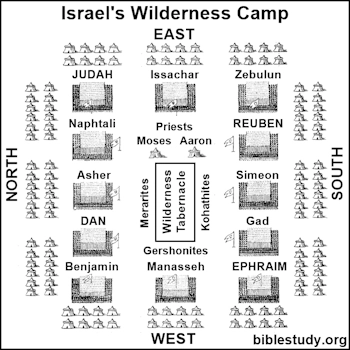
The tribes are arranged in a very specific order around the tabernacle, with the Levites surrounding it and the tabernacle at the center. This visually reinforces a central truth: God is at the center of Israel’s life. Their physical arrangement mirrors their spiritual priority. Every tribe’s position is intentional, suggesting unity, structure, and dependence on God’s presence. Israel doesn’t just travel together—they are organized around something sacred.
What I love about all of this is how clearly every single tribe has a role. No one is random, no one is extra, and no one is overlooked. Each group shows up differently, with different responsibilities, but all of it matters. It actually reminds me a lot of family life—everyone has their own strengths, their own rhythms, their own place in the bigger whole. And somehow, it all holds together. The message underneath it all feels simple but steady: we all have a part to play, and the whole only works when each person shows up as they are, where they are.