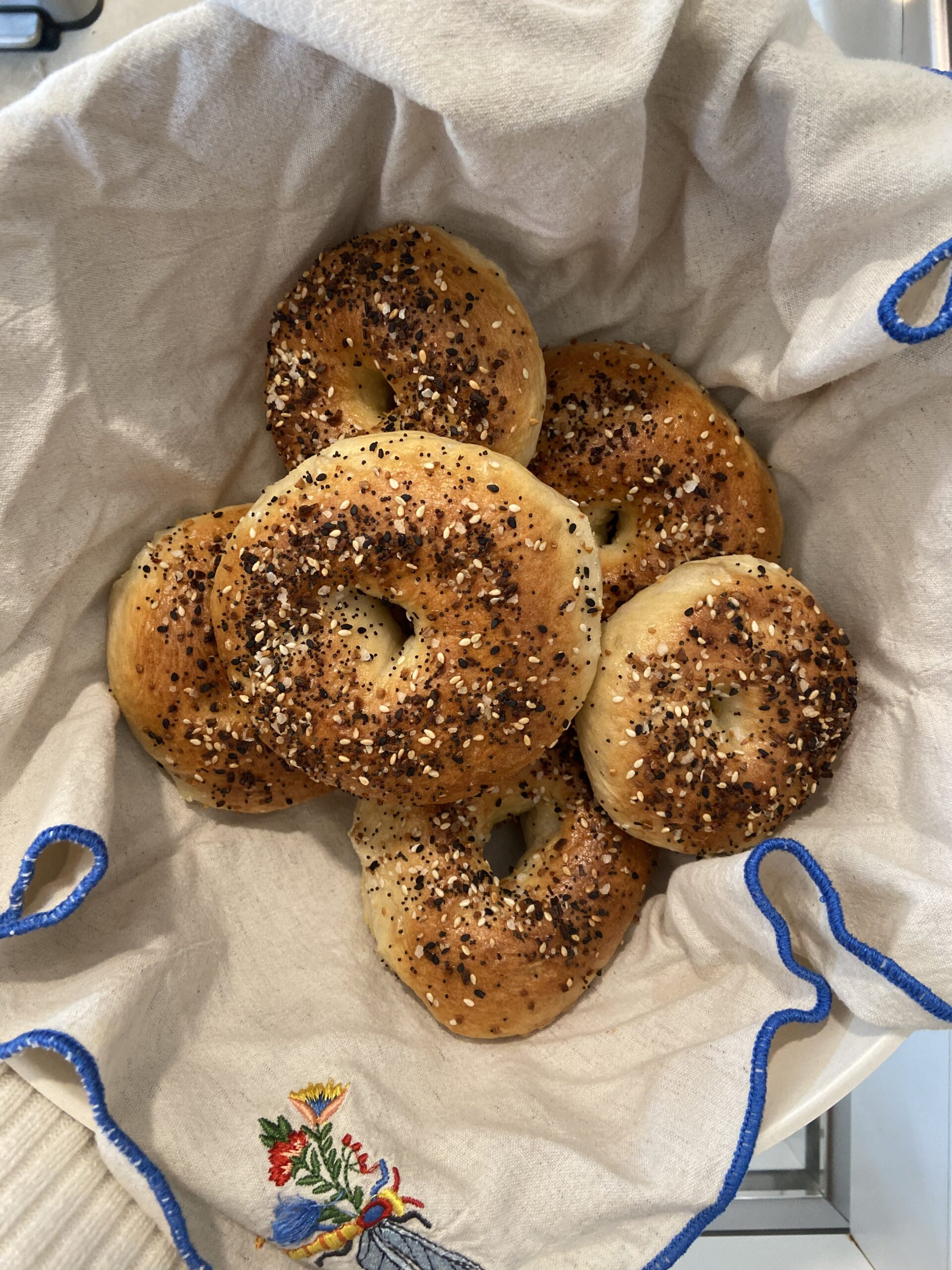
We started last week off with a fantastic Fathers Day brunch at my in-laws. I brought homemade bagels (recipe here), we had the whole local St. Louis family, plus my husbands sister, visiting from NYC, and it set a really nice tone for the week. Relaxed, slow-paced, and easy. If I could draft up a perfect summer week, this past week would be it. We’re walking into our second (third?) heatwave of the summer this week, which…. isn’t fun. Especially for my chickens. They don’t particularly care for frozen watermelon rinds, but maybe they’ll get desperate enough this time.
Meanwhile. We open with another double parsha, which is kind of a shame, because each one, Chukat and Balak, are each profound in their own way, and I really wish I could dedicate one full post to each. Oh well. Chukat, because Israel is given a very interesting punishment, but also the cure, it deals with the death of Aaron and Miriam, and there’s a lot of unpack. And Balak. Well. That’s the story of the talking donkey, and again. Could be its own post. I’m going to do my very best this week. Especially since I’m writing this day of, with a baby on my hip.
So Much Death
Crazy observation, but we learned a lot, in the pages between Leviticus through right now, about how to handle the dead; died of natural causes, or someone who was killed, and the impurity that comes afterwards, but… what about when people die by Gods hand? Remember last week? When the earth swallowed up Korach? And the other group of rebells that perished by fire? And this week, we have many dead by fiery serpents (21:6) sent from God himself. Do the same rules apply? Asking for a friend.
So, yes, fiery serpents. Let’s back up. Israel complains to Moses again (again, a-g-a-i-n), about the lack of grain, figs, vines, and water. At this point, I am so sick of reading about the same complaints. It’s like these people learn nothing. Or at least their long term memory isn’t fully developed, I don’t know. In all fairness, God didn’t really punish them for food-related complaints, so maybe they’re simply doing what Jews do best: complaining. Imagine being stuck in a desert with hundreds of thousands of Larry Davids. But so far, the pattern seems to be complaints, God is angry, Moses vouches for them, God says OK, rebellion uprising from the people, God is angry, Moses begs God not to wipe them out, minor punishment instead, rinse and repeat. I’m willing to bet that the Torah leaves out many more instances of the complaints, there’s just so much one can write before the reader finds the writing unbelievable, and we’re sort of approaching that line now. There. I said it.
The Copper Serpent
So back to the lack of grain, figs, vines, and water. God sends fiery serpents. And interestingly, as a cure, God tells Moses to craft a copper serpent….and just by looking at it, said person will be healed. The copper serpent is a really interesting piece, at least to me, and though it’s only two quick verses, I find it worth stopping to note.
The object of healing happens to be looking head-on, directly at the same object that put you in this position in the first place. I really like the power of that:
Then the Lord said to Moses, “Make a seraph figure and mount it on a standard. And if anyone who is bitten looks at it, he shall recover.” Moses made a copper serpent and mounted it on a standard; and when anyone was bitten by a serpent, he would look at the copper serpent and recover (21:8-9).
My Best Friend, Satan
Parshat Balak is a bit bonkers, but also a fantastic parable, and also a cute little side story to the main narrative, that in my mind, solidifies God’s alliance with Israel. Chapter after chapter, we witness God getting so frustrated with Israel, that one can almost get a sense that He’s simply going to give up on them. I mean… wouldn’t you? So I almost take comfort reading about God’s allegiance to Israel through a handful of nations that are ready to destroy them.
This may be the first time we’re introduced to a satan (pronounced sah-tan), and it’s a bit different that the Christian version. Whereas Satan, Capital S, is one fallen angel, who is king of this realm. Whereas in Judaism, there is an idea that we all have a satan, our own little personal one, sort of like the 1950’s cartoons of an angel on one of your shoulders, a devil on the other. Think the yetzer Hara, right? And the point of your personal satan, your own personal adversary, is to grow you, sharpen you, change you, turn you into the best and highest level of you, that you can be, while you’re earth-side.
Two, maybe three years ago, Alex and I went to an event featuring Rabbi Leiby Burnham, his breakout seminar, entitled My Best Friend, Satan was absolutely fabulous, and it’s a talk I still think about regularly. Basically, to water down his lecture into one / two sentences: our greatest obstacles are often our greatest teachers, so thank you Satan!
Here, the satan doesn’t tempt Balaam into evil. Quite the opposite. The adversary stands in his path, preventing him from heading further down the wrong road. Even more ironically, Balaam’s donkey sees the messenger of God long before the prophet does. The animal has clearer spiritual vision than the man who’s supposed to be speaking for God.
That’s funny. But it’s also humbling. Sometimes the obstacle in front of us isn’t there to keep us from God’s will. Sometimes it is God’s will. Anyway, Rabbi Burnham came immediately to mind when I read Balak.
As we close out this week’s double parsha, no surprises here, God becomes incensed with Israel yet again (again). See you next week. And God speed for the heat wave that is supposed to go from Sunday through Friday.