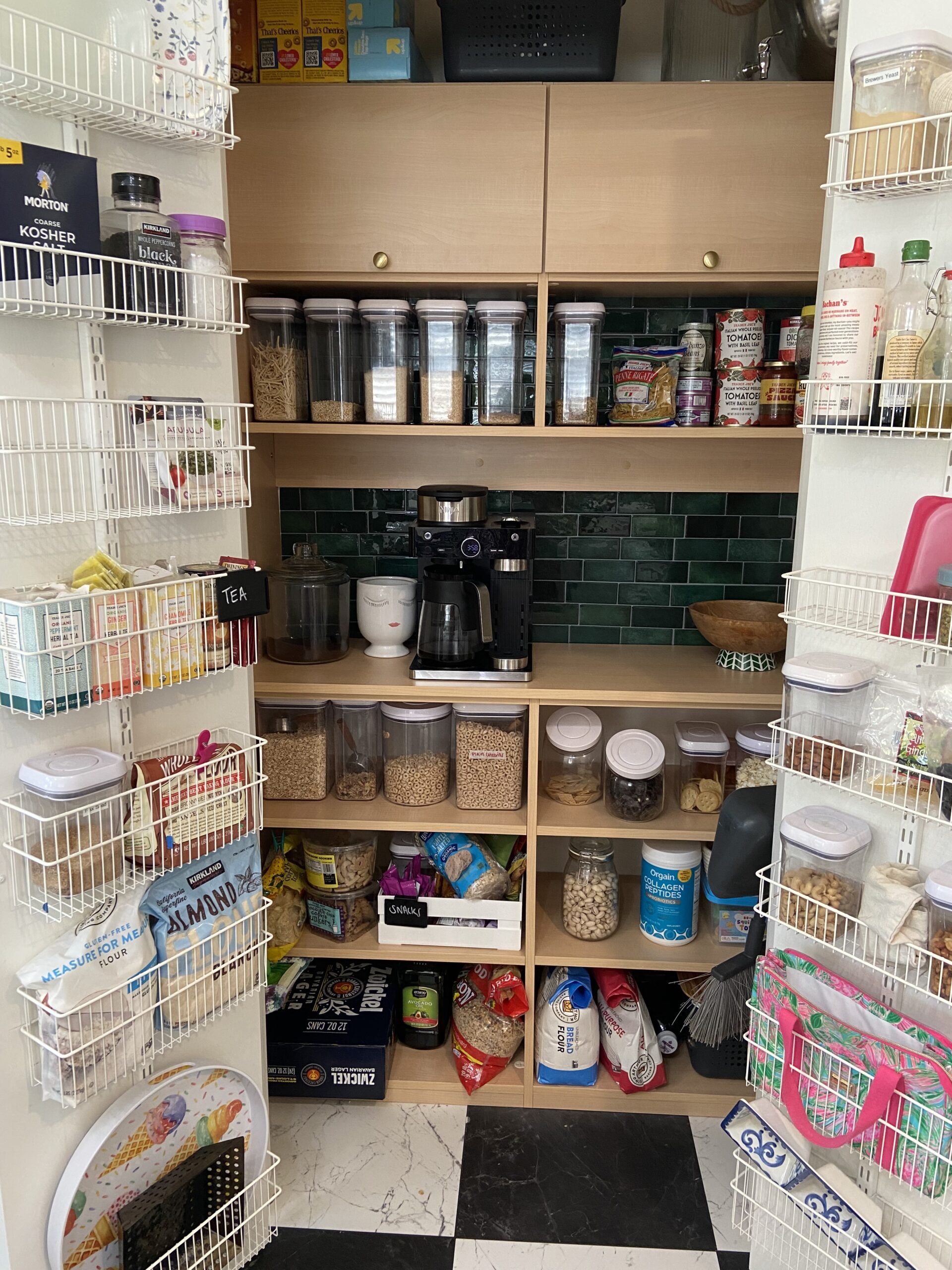
A few weeks back, I mentioned we wrapped up the heavy lifting for our kitchen refresh. We installed new flooring, lighting, emerald green backsplash, and wooden accent shelving for our kitchen, a space that I love dearly, even with its white formica counters. And this week, the final piece of the puzzle was put in place: the pantry. I couldn’t be happier with how it turned out. I mean, anything would have been better than builder-grade white wire shelving (though we did leave the behind the door wire shelves, as noted in the photo), I am over the moon with the completion of the kitchen.
Speaking of the kitchen… the timing is quite neat here, because the parsha this week, Re’eh, opens with another decree from Moses, and discusses many more laws. For this particular parsha, the laws concern kashrut (kosher) foods, debt, tithing, and holidays. I find it really interesting that Moses begins with laws of what we can and cannot eat, laws of kashrut (kosher), items that God finds abhorrent for human consumption. It has been speculated, that laws of kashrut are giving first, because it is the physical act we participate in the most — think about how many times a day we eat a meal, have a snack, compared to anything else we do in this physical world. I genuinely believe God wants us to enjoy this physical world, if anything, we were given taste buds to really enjoy our food and beverages. It’s a gift. We did not have to be endowed the gifts of smell and taste. And yet, here we are. Creating the most delicious and elaborate meals, with so many wonderful and complimentary flavors. Take for example my favorite summer salad, a strawberry-cucumber-pecan-feta salad, paired with a balsamic dressing. Bursting with summer flavors, and the amount of joy it brings to assemble and consume is quite high. Anyway, just one small example.
Kosher-ish
I am going to admit, growing up as a secular Jew in America, my family kept very loosey-goosey kosher rules. We did have two sets of dishes and silverware, however, most of the snacks in our pantry were not kosher. If we had take-out, we used disposable paper plates, but nothing was off limits while dining out. In fact, McDonalds was a staple in my childhood home. I grew up in the DC suburbs in Maryland: “CRAB CAKES AND FOOTBALL! THAT’S WHAT MARYLAND DOES!” And I never really gave it much thought. A running joke my husband shares, is on our first date (in Bethesda, Maryland) waxing on about the importance of raising Jewish children, and he’s sitting there trying not to burst out laughing at the rich irony, while I’m dipping my crab cake appetizers in aioli. Fast forward twelve years, and the meals I serve for our family of six no longer include bacon, shrimp, and no more crab cakes. I’ve come a long way.
This is a longer conversation, but I’m thinking about what it means to eat kosher, today, according to Orthodox Jewish standards. As I’ve studied Torah over the past year, I’ve realized that many of the kitchen practices I associate with “keeping kosher” aren’t written explicitly in Deuteronomy. I’m trying to understand how we got from the verses in the Torah to the detailed practices in a modern kosher kitchen. Specifically about having separate meat and dairy everything. And I keep thinking back to: “You shall not add to the word which I command you, nor take from it, that you may keep the commandments of the Lord your God which I command you.” (Deuteronomy 4:2). Why is my kitchen any less Kosher because I have one Dutch oven that I use to cook meat dishes, and also dairy ones in? Why isn’t my silverware kosher, even though they get washed between meals? Does God somehow look down on this? Is my kitchen somehow not up to Gods standards? I wonder how God views an imperfect but sincere attempt to build a Jewish home. Is He looking first at my cookware, or at the heart that’s trying to honor Him while still learning?
I’m genuinely asking to learn. Perhaps I should sit down with one of the many rabbi’s in our cherished communities. There are two areas that I know I could immediately improve upon:
- Buying exclusively kosher meat at the store, ensuring that the proper measures are taken to remove the blood from the animal, which God himself mentions is quite important
- Not mixing meat and milk in the same dish. This is much harder for me, because I love cooking elaborate pan sauces, the base being butter, to go over a piece of chicken. Butter makes everything taste better. Cheese is a fabulous addition to most meals, bringing an extra component of salt. Though when God says not to boil a kid in its mother’s milk — I get that. That is cruel, that is literally the definition of mixing life and death. But what about chicken, who does not produce milk, and cheese? What about my balsamic chicken and feta salad? Are we adding to God’s law? I know what my rabbi would say, but what about what God would say? Are these just semantics?
I’ve been thinking about this more and more as the years tick by. There are a few small improvements I’ve made. I have the best pasta bolognese recipe, and originally, I used to simmer the meat in a cup of milk, followed by a cup of white wine. Now, I simmer the meat in a cup of vegetable broth, followed by a cup of white wine. And guess what? It still tastes just as good. However, at the end, I load up each bowl with a generous helping of freshly grated Parmesan cheese. I suppose that cancels out the boiling of meat in milk. But small steps, small steps.
I’ve modified a handful of other family stapes to be kosher-adjacent over the years, though my kitchen would never pass as a kosher kitchen. None of my orthodox friends would ever sit down to meal with us, in my home. And there’s something about that that’s deeply painful, and makes me feel all sorts of feelings. But at the same time, I’m really content cooking in my kitchen, and really happy with the meals I serve, and I know there’s a lot of good that God sees, and recognizes. I’m proud of the whole foods, nutrient dense, seed-oil free, preservative free, bio-engineered free, from scratch cooking, and baking I do to nourish my children, my husband, myself, and those who join us for meals. I love my cooking ware, my fiesta ware plates, and the flow of my kitchen. And while I don’t see myself changing much about the way I cook and show up for my family, I’m always open to small tweaks, such as the bolognese example. But what about my favorite whole roasted chicken, a chicken that’s roasted with butter, lemons, and rosemary, a dish that I love to serve on chilly fall evenings when we have company? I’m sorry, but no, not right now. I’m open to small step changes, one recipe at a time, but again, I don’t see myself having a ‘orthodox approved’ kosher kitchen anytime soon. Does that make me any less of a Jew?
Re’eh contains much more than the laws of kashrut. It speaks about generosity, debt, pilgrimage festivals, and caring for one another. But this week it was the food laws that stayed with me, perhaps because I spend so much of my life in the kitchen. I suspect this is a conversation I’ll continue having with rabbis, and perhaps with God Himself. For now, I’ll keep making dinner. I’ll keep trying to build a Jewish home. I’ll keep asking questions. And maybe that’s part of the point—not pretending to have arrived, but continuing to seek.